Can AI help scientists design cancer medicines?
For people with advanced cancer who have already tried several treatments, every new option being studied matters, especially when the cancer has reached the brain, where many medicines struggle to go. A company says AI helped design an experimental pill that doctors are now testing with them. Here's what the early results show, what they don't, and who's behind them.
Early research, with no comparison group, and not peer-reviewed. General information, not medical advice.
What's being tested
IAM1363 is an experimental once-a-day pill from Iambic Therapeutics for cancers driven by HER2, a protein that can fuel tumour growth. It's being tested in breast, lung, stomach and other cancers, and it's built to reach the brain.
Iambic says its AI platform helped design the pill. That's the company's claim. One of its AI tools is described in a peer-reviewed paper, but no independent paper shows how AI shaped this particular molecule. The company also says the project went from start to clinic in about two years; that's the company's own figure.
Who's taking part
Doctors at hospitals in the US, Europe and South Korea are running the trial. By Aug 31, 2026, 122 people had taken the pill. Most had already had about three rounds of treatment for advanced cancer, 61% had already had a strong HER2 medicine called T-DXd (Enhertu), and 44% had cancer that had spread to the brain or spinal cord.

What the early results show
The results were shared as a poster at the European cancer congress (ESMO 2026) in Madrid on Oct 23.
- Across the body: among 53 people with a matching HER2 change on the higher doses, tumours shrank in 19 (best response). 12 of 53 were confirmed on a follow-up scan, and 4 more were waiting for one.
- In the brain: among 22 people with measurable brain tumours, brain tumours shrank in 9. 4 of 22 were confirmed, and 1 more was waiting.
- Three people with HER2-positive breast cancer had confirmed brain responses after two strong HER2 medicines. One of them had more than 50 brain tumours.
The confirmed numbers are the ones the trial itself is set up to measure, so they're the ones to watch as more results come in.
Side effects
Side effects were mostly mild, but stomach upset was common. Of 103 people on the higher doses, 59% had diarrhoea, 53% had nausea and 49% had vomiting at some point. At the chosen 960 mg dose, 4 of 68 people (5.9%) had a serious (grade 3) side effect linked to the drug.
Keep it in perspective
- It's early. The registry lists it as Phase 1 (the company calls it Phase 1/1b), and its main job is to test safety and dose.
- There's no comparison group, so we can't say how it compares with other medicines.
- It isn't peer-reviewed. The results come from a conference poster and a company press release.
- The groups are small (53 and 22 people) and mix many cancer types and HER2 changes. There's no data yet on how long responses last.
- It's still investigational, and no regulator has signed off on it.
- Whether any trial or treatment is right for someone is a conversation with their own care team. The clinician decides.
Who's behind it
Iambic sponsored the study, and two of the 20 poster authors work for the company. The presenting author, Dr. Ecaterina Dumbrava of MD Anderson, lists research funding from many companies, including Iambic.
Iambic listed on Nasdaq on Oct 15, 2026, 11 days before its Oct 26 press release, so it has a financial reason to share good news. Its own prospectus calls its approach "novel and unproven." The AI role is the company's own description.

Read more
- The poster (primary data): Dumbrava et al., "Safety and Activity of IAM1363, a CNS-penetrant HER2 TKI in Participants with HER2 Altered Advanced Cancers," ESMO 2026 poster FPN 1072P, Oct 23, 2026.
- Iambic's SEC prospectus, pp. 144–145, for the confirmed counts (12 of 53 and 4 of 22).
- The trial's registry entry (NCT06253871), ClinicalTrials.gov.
- Iambic's press release, Oct 26, 2026.
- Independent trade coverage, Small Molecule News.
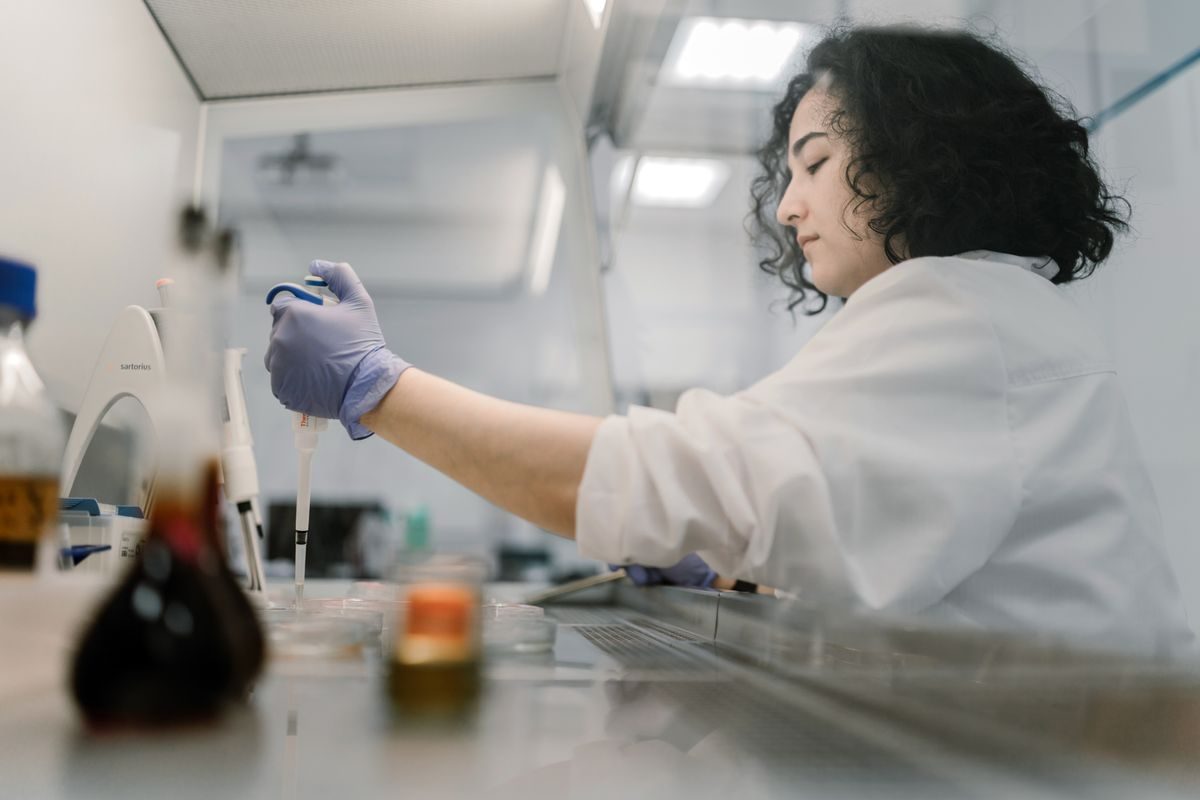
Illustrative photos, not from the study. Photos: Mikhail Nilov, Cedric Fauntleroy and RDNE Stock project, all via Pexels.
General information, not medical advice. Talk to your own care team about your health.
Get the next one
One free email a week on AI in medicine and dentistry. Minus the hype.
Form not loading? Subscribe here.